In today’s rapidly evolving financial landscape, the use of artificial intelligence (AI) in principal investment has emerged as a game-changer. Principal investment, a cornerstone of the financial industry, involves deploying capital to generate returns, typically through the acquisition of assets or securities. AI is revolutionizing this age-old practice by providing investment professionals with powerful tools to make more informed and data-driven decisions. In this article, we delve into the fascinating world of AI in principal investment, exploring its applications, benefits, and potential challenges.
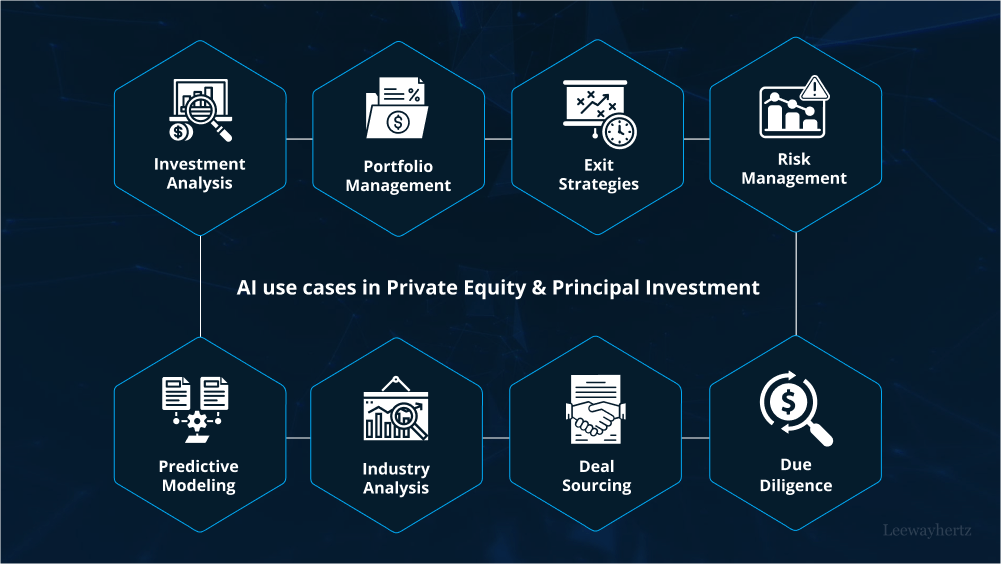
AI-Powered Investment Strategies
AI’s impact on principal investment is most evident in the realm of investment strategies. Machine learning algorithms, a subset of AI, excel at identifying patterns and trends within vast datasets. Investment professionals can harness this capability to develop and refine their investment strategies.
One notable application of AI in this context is quantitative analysis. By feeding historical market data into AI models, investors can uncover hidden correlations and formulate trading strategies that adapt to changing market conditions. These strategies can be automated, allowing for real-time execution and adjustments, which is especially advantageous in fast-paced financial markets.
Risk Management and Predictive Analytics
Another critical aspect of principal investment is risk management. AI plays a pivotal role in this domain by offering advanced predictive analytics. Through sophisticated algorithms, AI systems can assess the potential risks associated with investment decisions. These systems can analyze various risk factors, including market volatility, economic indicators, and geopolitical events, to provide more accurate risk assessments than traditional methods.
Furthermore, AI can facilitate scenario analysis, enabling investors to evaluate the impact of various economic scenarios on their portfolios. This capability is invaluable in preparing for potential market downturns or unexpected events, allowing investors to proactively adjust their strategies.
Enhanced Decision-Making
AI in principal investment also enhances decision-making by providing investors with data-driven insights. Natural language processing (NLP) algorithms can process and analyze news articles, social media sentiment, and other textual data to gauge market sentiment and sentiment shifts. This information can be integrated into investment models to make more informed decisions.
Additionally, AI-driven tools can assist in asset valuation. These systems can analyze financial statements, market data, and industry trends to determine the fair value of assets. This level of precision is difficult to achieve manually and can significantly reduce the risk of overpaying for assets.
Efficiency and Automation
One of the primary advantages of AI in principal investment is increased efficiency and automation. Tasks that would typically require significant manual effort, such as data analysis, portfolio management, and trade execution, can be streamlined through AI-driven solutions. This not only reduces the potential for human error but also frees up investment professionals to focus on higher-level strategic decisions.
Furthermore, AI can facilitate algorithmic trading, where buy and sell orders are executed automatically based on predefined criteria. These algorithms can respond swiftly to market changes, helping investors capitalize on opportunities and manage risk more effectively.
Challenges and Considerations
While AI brings tremendous potential to principal investment, it is not without challenges. One of the primary concerns is the potential for algorithmic bias. AI systems learn from historical data, which may contain biases. If not properly addressed, these biases can lead to unfair or suboptimal investment decisions.
Additionally, the complexity of AI models can make them difficult to interpret and explain. Investors and regulators may require transparency in decision-making processes, which can be challenging when using complex AI algorithms.
Cybersecurity is another critical consideration. As AI systems become integral to principal investment, they become attractive targets for cyberattacks. Safeguarding these systems against data breaches and other security threats is of paramount importance.
The Future of AI in Principal Investment
AI’s role in principal investment is poised to grow further in the coming years. As AI technologies continue to advance, investment professionals will have access to more sophisticated tools for data analysis, risk management, and decision-making. Moreover, the integration of AI with blockchain technology is expected to revolutionize asset ownership and trading, further reshaping the landscape of principal investment.
In conclusion, AI in principal investment is ushering in a new era of data-driven, efficient, and informed decision-making. While challenges and considerations exist, the benefits of using AI in this field are undeniable. Investment professionals who embrace AI stand to gain a competitive edge in an increasingly complex and dynamic financial environment. As AI continues to evolve, its impact on principal investment is set to be nothing short of transformative.
 AI Techy Talks