In the ever-evolving landscape of healthcare, the integration of cutting-edge technologies has ushered in a new era of diagnosis, treatment, and patient care. Among these transformative technologies, Generative Artificial Intelligence (AI) has emerged as a powerful tool with the potential to revolutionize the healthcare industry. This article explores the role of Generative AI in healthcare, shedding light on its applications, benefits, and challenges.
What is Generative AI in Healthcare?
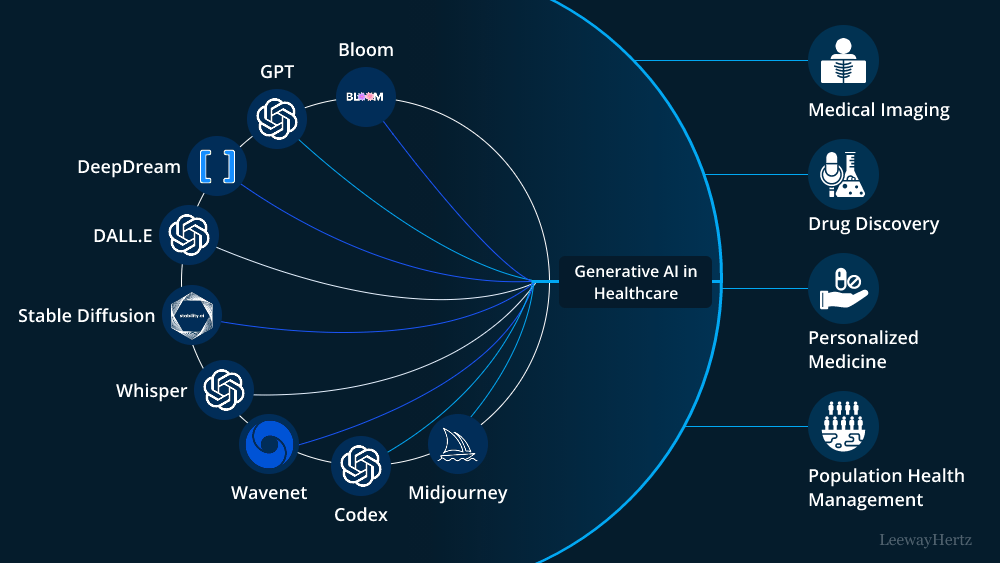
Generative AI refers to a subset of artificial intelligence that focuses on creating content, data, or even new knowledge. In healthcare, it leverages algorithms to generate valuable information, such as medical images, patient reports, and drug compounds. Unlike traditional AI systems that rely on predefined rules, Generative AI possesses the ability to learn and adapt, making it a versatile tool in healthcare innovation.
Applications of Generative AI in Healthcare
- Medical Image Generation: One of the most prominent applications of Generative AI in healthcare is the generation of medical images. These AI systems can create high-quality images, such as MRI scans, X-rays, and CT scans, to aid in the training of healthcare professionals and improve the accuracy of medical diagnoses.
- Drug Discovery and Development: Generative AI accelerates drug discovery by designing novel compounds and predicting their properties. By analyzing vast datasets and generating molecular structures, it helps pharmaceutical companies identify potential drugs faster and with higher precision.
- Electronic Health Records (EHRs): Generative AI can assist in maintaining EHRs by automatically generating patient reports, ensuring consistency and reducing the administrative burden on healthcare providers. This allows clinicians to focus more on patient care.
- Natural Language Processing (NLP): NLP models powered by Generative AI can analyze vast volumes of medical literature and generate summaries or answer specific medical questions. This aids in research, literature reviews, and evidence-based decision-making.
- Personalized Treatment Plans: Generative AI can analyze patient data to generate personalized treatment plans. By considering a patient’s medical history, genetics, and current health status, it can suggest tailored therapies, improving the efficacy of treatments and reducing side effects.
Benefits of Generative AI in Healthcare
- Enhanced Diagnostics: Generative AI assists healthcare professionals in making more accurate and timely diagnoses. It generates high-quality medical images and helps identify subtle patterns that might be missed by the human eye.
- Drug Discovery Acceleration: The drug discovery process, which typically takes years, can be significantly expedited with Generative AI. This not only reduces costs but also brings potentially life-saving medications to market more quickly.
- Efficiency and Automation: By automating tasks like EHR management and report generation, Generative AI allows healthcare providers to allocate more time to patient care, improving overall efficiency in healthcare delivery.
- Personalized Medicine: Tailoring treatments to individual patients can lead to better outcomes and fewer adverse reactions. Generative AI plays a pivotal role in generating personalized treatment plans based on a patient’s unique characteristics.
- Medical Research Advancement: Generative AI aids researchers by analyzing vast amounts of data and generating hypotheses, expediting the pace of medical discoveries and innovations.
Challenges and Considerations
While Generative AI holds immense promise in healthcare, it also presents challenges and ethical considerations:
- Data Privacy: The use of patient data for AI training must adhere to strict privacy regulations to protect patient confidentiality.
- Bias and Fairness: Generative AI systems can inherit biases present in training data. Ensuring fairness and unbiased decision-making remains a crucial concern.
- Regulatory Compliance: The integration of Generative AI in healthcare requires compliance with regulatory bodies to ensure patient safety and data security.
- Interoperability: Ensuring that Generative AI systems can seamlessly integrate with existing healthcare infrastructure is essential for their effective adoption.
- Ethical Use: Decisions made by AI, especially in critical healthcare scenarios, should be transparent and interpretable to maintain trust among healthcare providers and patients.
Conclusion
Generative AI in healthcare represents a transformative force that has the potential to reshape the industry. From enhancing diagnostics to accelerating drug discovery and personalizing treatments, its applications are vast and promising. However, addressing privacy concerns, biases, and regulatory challenges is essential to harness the full potential of Generative AI in healthcare. As this technology continues to evolve, it offers the prospect of better patient outcomes and a more efficient healthcare system, ultimately improving the quality of healthcare worldwide.
 AI Techy Talks